Sambuvaraiyar House of Kadambur
Ponniyin SelvanThe Sambuvaraiyar House of Kadambur is both a hereditary political power and the host of a succession crisis that brings rival claims, family ambition, and royal authority into the same palace. Its old hostility toward the Thirukkovilur Malayaman line helps draw it toward Madhuranthaka Thevar, but Sambuvaraiyar’s hopes for Manimekalai’s future make that allegiance vulnerable to change when Aditha Karikalan arrives.
Lineage and Political Standing
The family presents its authority through descent from Valvil Ori, the celebrated warrior whose heirs, it claims, it represents. The Sambuvaraiyars inherit not only Ori’s friends but also his enemies: their ancestral hostility toward the descendants of Thirukkovilur Malayaman makes Aditha Karikalan, a grandson and heir of that rival line, an unwelcome prospect as successor to the Chozha throne. At the royal welcome, the herald identifies Sambuvaraiyar as an enduring ally of the Chozha Chakravarthy, guardian of Veera Narayana Lake, and commander of the Valiant Five Thousand. The ceremonial titles present the house as a military and territorial power whose standing rests on both its own lineage and its service to the dynasty.
That inherited rivalry shapes the house’s response to the succession dispute. Sambuvaraiyar’s dissatisfaction with Aditha grows into loathing, in part because he regards the prince as arrogant and dismissive of the assembled lords. The family consequently embraces Madhuranthaka Thevar’s claim with renewed commitment. Its position is thus not presented as a detached judgment on inheritance: dynastic memory and a sense of injured status help determine which claimant appears acceptable.
Kadambur as a Political Stage
The palace becomes a meeting place for nobles attempting to prevent armed conflict. With the Pazhuvettarayars and Kodumbalur Velaar expected to fight, the lords assemble at Sambuvaraiyar’s residence; Aditha is among those drawn into the gathering. When his arrival is anticipated, the palace and its gates are decorated with flags, buntings, and garlands, while guards are posted more heavily than before. The extensive entourages of Periya Pazhuvettarayar and his consort add to the spectacle, and the town remains animated by the expected visits and political business.
The welcome turns the house’s hospitality into a public display of rank. A large crowd gathers at the palace entrance, and the crush becomes so intense that spectators climb trees and attempt to scale the fort wall before sentries drive them back. Aditha, Parthibendran, and Vandhiyathevan reach the gates on horseback after the larger retinue has been held up by the crowds. The heralds then recite the prince’s royal ancestry and martial standing, followed by a proclamation that Sambuvaraiyar welcomes him to the palace. The ceremony places Kadambur’s lord in the role of host to the crown prince, even as the gathering exposes the political divisions surrounding the succession.
Succession Dispute and Negotiation
Aditha directly asks Sambuvaraiyar and Periya Pazhuvettarayar to advise him about the throne. He recalls that his father publicly made him heir, then raises reports that the emperor now wishes to install Madhuranthaka Thevar instead. His question makes the dispute explicit: he asks whether it is just to expect him to yield and whether refusal would be unfair. The request turns a tense courtly gathering into a test of what authority the assembled nobles claim to exercise.
Periya Pazhuvettarayar answers that Madhuranthaka’s claim cannot simply be dismissed and proposes dividing the kingdom, with territories north and south of the Kollidam assigned to different claimants. He presents the proposal as a compromise that might avert further danger to the kingdom, but Aditha rejects dividing the realm. The exchange reveals how succession arguments can become proposals to redistribute the kingdom itself. In the same confrontation, Aditha accuses Periya Pazhuvettarayar and his faction of restricting access to the emperor and of responsibility for the order against Arulmozhi Varman. Those accusations are directed at the Pazhuvettarayars, not established as actions by Sambuvaraiyar; their significance for the house is that its palace hosts a dispute now entangled with distrust of royal and military authority.
Marriage Strategy and a Shifting Alignment
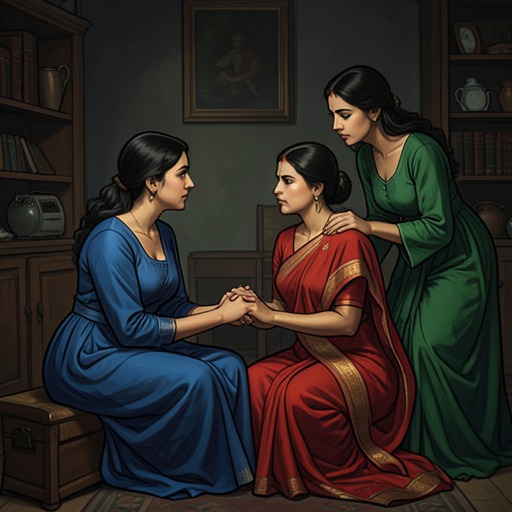
The house’s political calculations also run through Manimekalai’s proposed marriages. Kandamaaran first urges his sister to put aside her attachment to Vandhiyathevan and imagine a future as Madhuranthaka Thevar’s consort, with the prospect of becoming queen and her son one day contesting for the throne. Their parents support the plan, but Manimekalai does not welcome it. She has fallen in love with Vandhiyathevan and objects to Madhuranthaka’s reputation as an austere, untested warrior who is already married.
After the family abandons the Madhuranthaka plan, its hopes turn toward Aditha. Hints of a possible match flatter Manimekalai, and the anticipated arrival of the prince, together with Periya Pazhuvettarayar, raises her spirits. Kandamaaran also tells her that Nandhini is responsible for the new marriage efforts and that Manimekalai will have a central role in welcoming her at Kadambur. In this way, the household’s marriage plans link its private expectations to the rival political alignments represented by Madhuranthaka and Aditha.
Aditha’s arrival alters Sambuvaraiyar’s own outlook. Although he had supported Madhuranthaka against the prince, he begins to interpret Aditha’s visits to the women’s quarters and lively conversation with Manimekalai as signs that she has captured the prince’s interest. Manimekalai’s high spirits seem to confirm his reading. Sambuvaraiyar imagines her as future Chozha queen and their son as heir, with the honours now associated with the Malayaman family eventually passing to him. The prospect makes him reconsider opposing Aditha, but the evidence establishes Sambuvaraiyar’s hopeful interpretation, not a confirmed courtship or marriage. The house’s political significance lies partly in this instability: inherited enmity and support for Madhuranthaka can give way, in Sambuvaraiyar’s imagination, to the possibility of advancement through his daughter.